




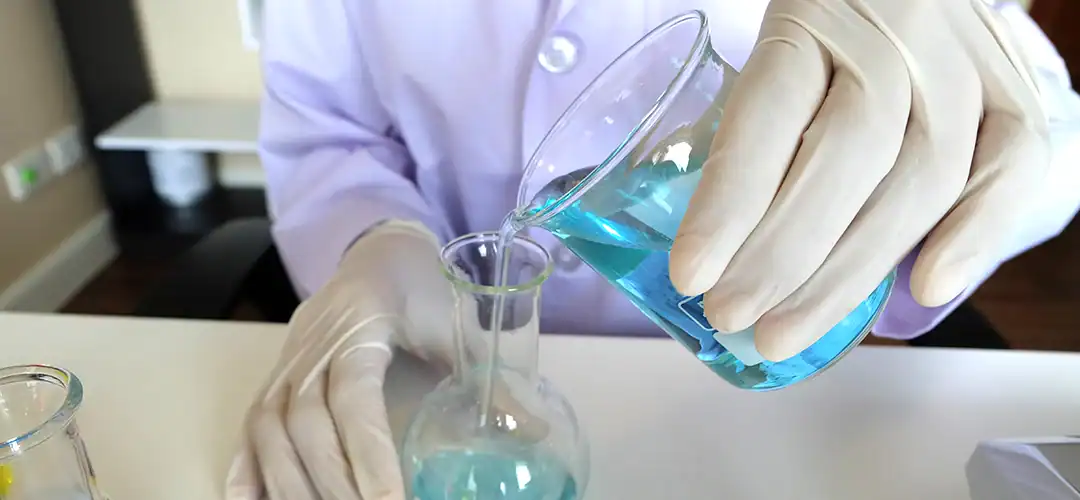
Chemical synthesis is central to modern chemistry. It describes how scientists build useful substances from simpler starting materials. Medicines, plastics, fragrances, and many other everyday products begin with these kinds of planned chemical changes. For students, it forms the bridge between reaction equations on paper and materials encountered in real life.
Disclaimer: This article is for educational purposes only. It does not contain medical, pharmaceutical, or practical advice, nor instructions for making medications or chemical products.
What chemical synthesis means
In plain language, chemical synthesis is the purposeful production of a desired substance from other substances, through one or more chemical reactions.
In broad terms, the process looks like this:
- Selecting starting materials ( reactants )
- Set controlled conditions (e.g. temperature, solvent, catalyst)
- Forming the desired product
- Check what exactly has been formed and separate the product from the rest
The key word here is purposeful . A random reaction is not the same as synthesis. In synthesis, the goal is concrete: to produce a specific molecule of sufficient quality and purity.
How Synthesis Works: The Basic Steps
Even when the chemistry becomes complex, the method usually remains recognizable.
- Route planning
Chemists map out the reaction pathway that can lead to the molecule they want to create. If multiple routes are possible, they compare them for efficiency, safety, cost, and waste. - Reaction step(s)
Reactants are brought together under controlled conditions so that bonds break and form in the intended way. - Isolation and purification
A reaction mixture usually contains more than just the target product. Therefore, the product must be separated from residuals and byproducts. - Verification
Analytical measurements confirm identity and purity. In practice, this is the moment when you verify that the process has truly achieved its intended purpose.
A useful way to look at this as a student: synthesis is both chemical understanding (reactions, mechanisms) and process control (reliable, repeatable outcomes).
Everyday example 1: a simple one-step reaction
A good teaching example of a one-step reaction is ester formation , often discussed in school when explaining fruity aromas. An ester is formed via a single nuclear reaction, and therefore it is often used as a clear one-step example of synthesis.
Esters include, for example, the well-known ester of ethanol and acetic acid , namely ethyl acetate .
Why students often find this example useful:
- You see a clear product result from one central reaction step.
- It makes clear that if you change the reactants, you also get a different product.
- It connects textbook theory with recognizable contexts such as flavors and fragrances.
Even in a simple one-step reaction, chemists still pay attention to yield, separation, and product control.
Everyday example 2: Aspirin as a context for multistep synthesis
Aspirin is well-known and therefore useful for introducing multistep logic in synthesis. Students often first encounter aspirin chemistry in simplified form, but in real-world production contexts, there’s more to it than just a single reaction equation.
The trade-off is usually clear:
- The target product sometimes requires intermediate steps.
- High purity requirements often require stricter purification.
- Scaling up from classroom scale to industrial scale adds process constraints.
Aspirin is therefore not only a recognizable example, but also a good illustration of why practical synthesis almost always goes hand in hand with quality systems and controlled production.
Everyday example 3: nylon/polymer synthesis
Nylon is a prime example of how synthesis can also yield very large molecules . Instead of creating a single small molecule and then stopping, polymer chemistry repeats bond-forming steps to create long chains.
Why it’s important:
- Synthesis is not limited to small molecules.
- Material properties (such as strength, flexibility and melting behaviour) depend on the molecular structure.
- Industrial chemistry links molecular design to product performance in textiles, packaging and engineering plastics.
Nylon also helps avoid a common confusion: making a molecule or material is different from formulating a final product.
Quick comparison: chemical synthesis vs. biosynthesis vs. production/formulation
| Concept | What is it? | Typical environment | Core process | Example |
|---|---|---|---|---|
| Chemical synthesis | Building a target substance from simpler reactants through planned reactions | Labs and chemical plants | Reaction design, conversion, purification, verification | Small drug molecules, polymer intermediates |
| Biosynthesis | Production of molecules by living systems (cells/enzymes) | Organisms, cell cultures, bioreactors | Enzyme-driven metabolic pathways | Proteins, many natural metabolites, fermentation products |
| Production/Formulation | Combine or process existing substances into useful products | Industrial production lines | Mixing, dosing, stabilizing, processing, packaging | Creams, detergents, coatings, final dosage forms |
A quick reminder:
- Synthesis = making molecules through reactions
- Biosynthesis = living systems make molecules
- Formulation/production = converting ingredients into a usable end product
Common confusions among students
- “Made in a factory” does not automatically mean “chemically synthesized from scratch.”
Many products are formulated primarily from substances that already exist. - “Natural” does not automatically mean that the final production route is biosynthetic.
A molecule can occur in nature and also be produced synthetically. - One-step examples in the classroom are basic knowledge, not the full industry picture.
In practice, this often includes purification, analysis, compliance and consistent quality control.
Conclusion
Chemical synthesis is the purposeful construction of substances through controlled chemical reactions. It can be simple (one main reaction step) or complex (multiple steps with strict quality control) and is the foundation of technologies that students encounter daily, from pharmaceuticals to polymers.
When you place synthesis alongside biosynthesis and formulation, the bigger picture becomes clear: chemistry is not just about reactions, but also about how molecules are designed, produced, and converted into useful products.