




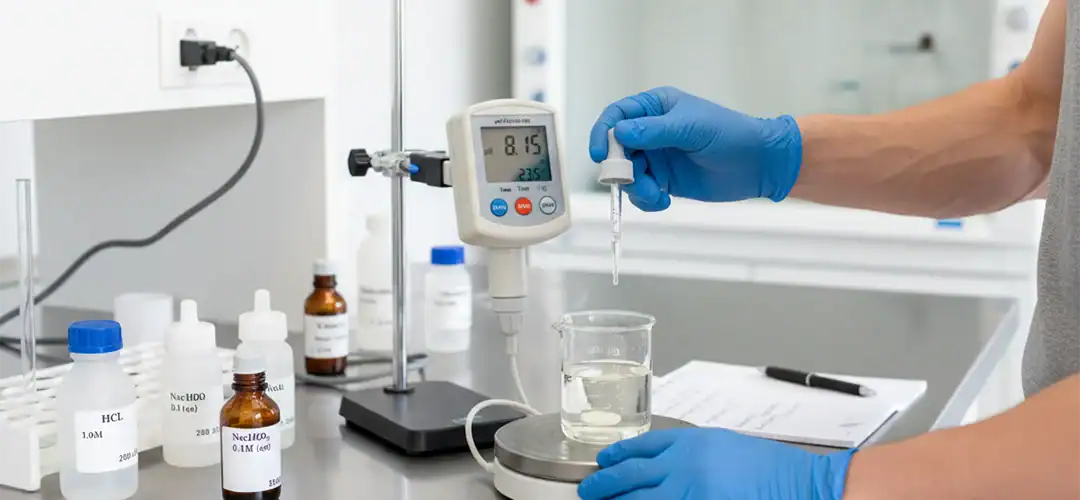
Adjusting the pH may sound like routine work, but that’s precisely where things often go wrong. One correction step too large and your sample suddenly behaves differently than expected.
This is reflected in solubility, reaction rate, extractions, and ultimately in your measurement results. Therefore, pH correction is not an afterthought, but a critical step in sample prep.
Below you will find a practical explanation with specific correction agents (including sodium bicarbonate), when to choose what, and how to avoid mistakes.
What exactly is pH correction?
In laboratories, pH correction usually means two things:
- Measurement correction: ensuring your pH measurement is reliable (calibration, electrode condition, temperature control).
- Sample correction: deliberately adjusting the pH of a sample to a target value or target range.
These two go together. If your measurement isn’t reliable, you’re essentially making blind corrections.
Why pH Correction Has Such an Impact
- Solubility: Many compounds dissolve better within a specific pH range.
- Stability: some substances degrade faster at too low or too high a pH.
- Selectivity: In extraction and separation methods, pH often determines the degree of ionization.
- Reproducibility: Small pH differences cause batch-to-batch variation.
What substances do you use for pH correction?
Lower pH (make more acidic)
- Hydrochloric acid (HCl) : strong acid, fast correction, high risk of overshoot if you work too concentrated.
- Acetic acid : weaker acid, often milder and more controllable in certain matrices.
- Citric acid : weak organic acid, useful where mild acid correction is desired.
Increase pH (make more basic)
- Sodium hydroxide (NaOH) : strong base, fast effect, but easy overshoot.
- Potassium hydroxide (KOH) : Similar to NaOH, choice often matrix- or method-dependent.
- Sodium bicarbonate (NaHCO₃) : mild base, suitable for gradual correction and less aggressive pH increase.
- Sodium carbonate (Na₂CO₃) : More basic than bicarbonate, still often more manageable than NaOH in some applications.
When is sodium bicarbonate a smart choice?
Sodium bicarbonate is useful for gently raising pH without causing aggressive jumps. It’s often helpful for slight corrections and systems where you want to minimize overshoot. Be careful, though: you’ll be introducing bicarbonate/carbonates into your matrix, which can be undesirable in some analyses.
Quick decision aid: agent versus application
| Resourse | Type | Speed | Overshoot risk | Typical deployment |
|---|---|---|---|---|
| HCl (diluted) | Strong acid | High | High | Rapid pH reduction, tight method limits |
| Acetic acid | Weak acid | Resourse | Low-medium | Milder acid correction |
| NaOH (diluted) | Strong base | High | High | Rapid pH increase |
| NaHCO₃ | Mild base | Low-medium | Low | Gradual pH increase |
| Na₂CO₃ | Moderately strong base | Resourse | Resourse | Basic correction without extreme aggressiveness |
Step-by-step workflow for reliable pH correction
1) Start with measurement quality
- Calibrate with appropriate buffers (preferably around the target range).
- Check electrode condition and response time .
- Ensure consistent temperature (or good compensation).
2) Measure the initial pH and determine your correction strategy
Decide beforehand: do you want a quick, tight correction (strong acid/base) or a gentler approach (e.g., sodium bicarbonate or weak acids)? Choose based on method requirements, not convenience.
3) Add in small steps
- Work with diluted correction solutions.
- Add drop by drop or in small aliquots .
- Mix each step well.
4) Allow to stabilize and measure again
Many samples react slowly. Wait briefly after each addition, especially with viscous samples, high salt contents, or complex matrices.
5) Stop in time
Don’t try to force “perfect to the hundredth” with large steps. It’s better to stay within the acceptable range in a controlled manner.
6) Document fully
- Initial and final pH
- Temperature
- Type and concentration of corrective agent
- Total added volume
- Time and operator
Practical examples
Example A: slight pH increase with sodium bicarbonate
Your sample is just below the desired range. Instead of using NaOH directly, choose a dilute sodium bicarbonate solution to increase the sample in a controlled manner. You add in small increments, mix thoroughly, wait for stabilization, and repeat until you’re within the desired range. The advantage: less chance of overshoot.
Example B: Quick correction with dilute NaOH or HCl
Your method requires a strict pH target and your sample has little buffer capacity. Diluted NaOH or HCl may be suitable, provided you work in small increments and monitor continuously. Important: overshoot is the biggest source of error here.
Buffering versus “hard correction”
In some methods, it’s better to use a suitable buffer system instead of constantly adjusting with a strong acid or base. Buffers keep the pH more stable during processing. However, buffer components can also cause matrix effects. Therefore, always choose according to your method.
Common Mistakes (and How to Avoid Them)
- Using overly concentrated correction solutions increases the risk of overshoot. Work diluted.
- Failure to allow stabilisation time will result in apparent stability and an incorrect final pH.
- Ignore temperature: pH and electrode behavior are temperature sensitive.
- Underestimating matrix effects: not every sample responds like a standard buffer.
- Incomplete logging: makes repetition and troubleshooting difficult.
- Blind backcorrection after overshoot: may unnecessarily change the matrix.
Safety in pH correction
- Wear suitable gloves, lab coat and goggles.
- Add acids and bases slowly and mix under control.
- Use clear labeling for corrected samples.
- Follow your local waste procedures for acidic/alkaline waste streams.
Conclusion
Proper pH adjustment isn’t a quick fix, but a controlled part of your method. If you choose the right substance, adjust in small increments, respect stabilization, and document everything, you’ll get more reliable data and fewer surprises.
Core rule: measure well, correct calmly, verify stability, document fully.